Google Ads Campaign Types in 2026: What Actually Works Now

Most people ask how to put ads on Google before asking what those ads should do. That's backwards. Google Ads campaign types are instructions handed to an algorithm already deciding, in real time, who sees your budget. A lot has changed between Google Ads campaign types 2025 and today, and Google Ads campaign types 2026 lean further into that automation. Whatever lands on the Google campaign slide starts here.
1. What Is Google Ads Actually Optimizing For?
Google Ads optimizes toward whatever conversion action you set — not pipeline, not revenue. Every campaign type, from a single Google Ads search campaign to Performance Max, points at that one number.
Smart Bidding chases whatever you define:
- Target CPA — cost per conversion
- Target ROAS — return on the conversion's declared value
- Maximize Conversions — raw count, no value weighting
Choose a campaign type after the business objective is clear:
- The platform can automate bidding, not decide whether a form fill is valuable
- More conversions can still hurt the business if they're weaker ones
- A conversion treats every form fill the same; a qualified lead adds a filter — fits the ICP, shows real intent
- Build that distinction into the conversion action itself
Google Ads sees vs. what the business needs:
- Google Ads sees: cost per lead, ROAS on tracked orders, conversion rate
- Business needs: cost per qualified opportunity, revenue after churn, close rate
A Google Ads plan tracking only the first list looks fine on a Google campaign slide and still misses the point.
2. How AI Is Changing Google Ads Campaign Optimization
How to put ads on Google has changed more in two years than the previous five: less manual bidding, more automated matching between intent and inventory. That's the real difference when comparing types of Google ads now: what Google is allowed to automate, and what signals you feed it.
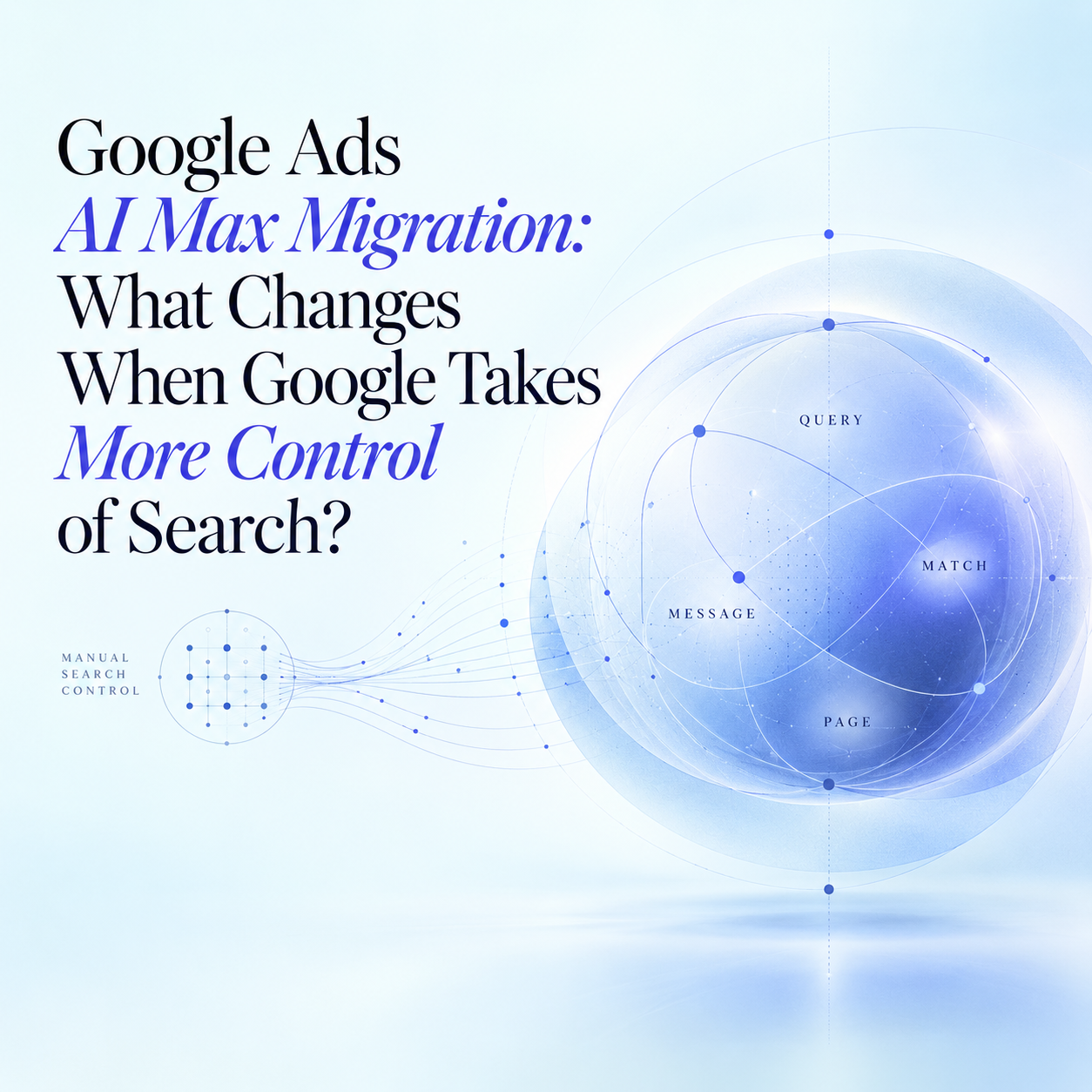
AI Max is an optimization layer for Google Ads Search campaigns. Enabled, it can:
- Match queries beyond your keyword list
- Generate ad copy from existing assets and landing pages
- Expand landing-page selection
Google reports that advertisers activating AI Max typically see :
- 14% more conversions at a similar CPA/ROAS
- 27% uplift for accounts still relying mostly on exact and phrase match
Those figures are Google's reported results, not a guarantee for every Google campaign.
Responsive Search Ads remain the standard format: up to 15 headlines and 4 descriptions, combined and served per query. The model assembles the ad but the advertiser still supplies:
- Clear audience signals
- Landing pages that match the query
- Enough real headline variety for the model to test
3. What Are the Different Types of Google Ads Campaigns in 2026?
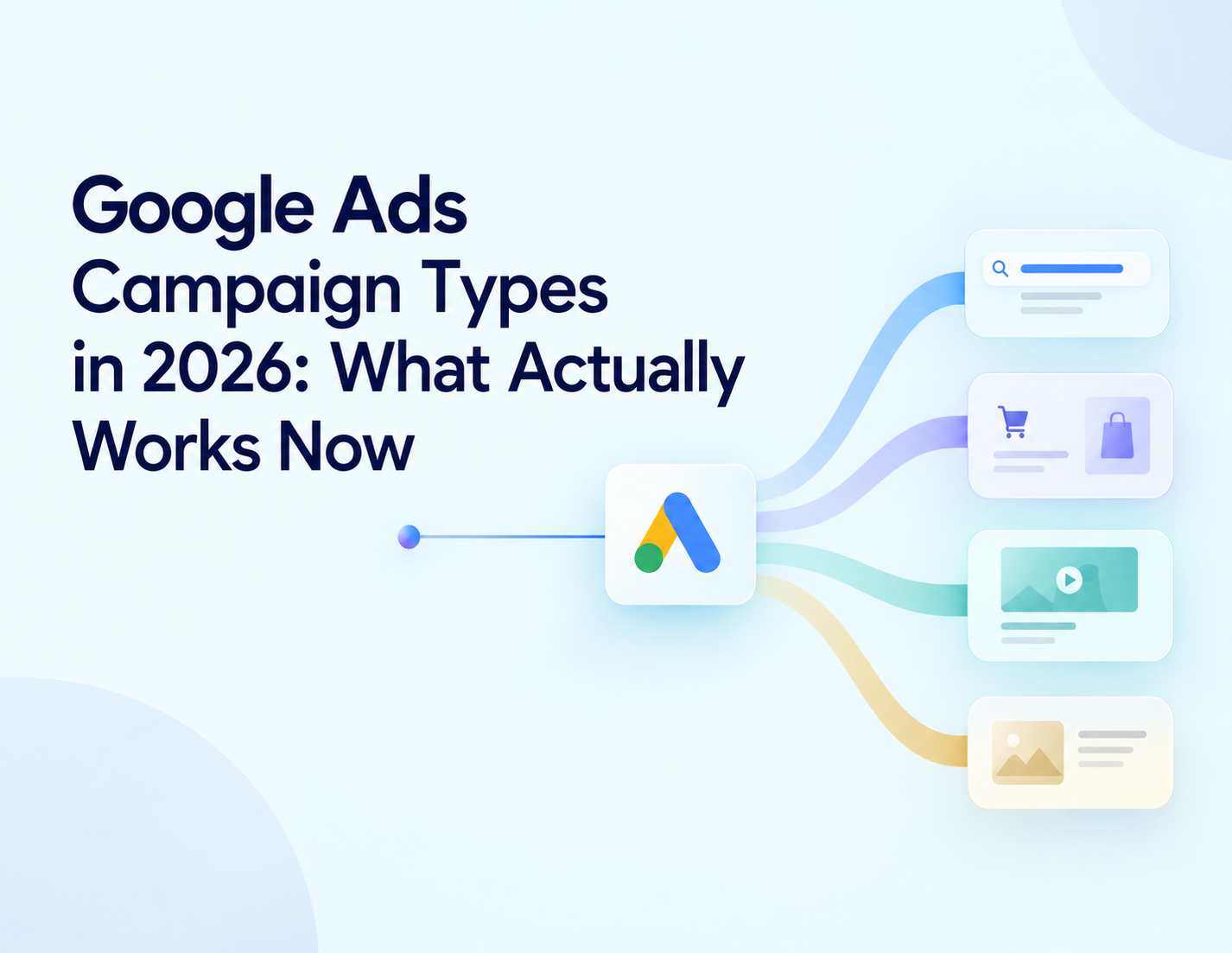
Google currently offers campaign types: Search, Display, Shopping, Video, Demand Gen, Performance Max, App, Local, Smart. Start with the business objective and buyer stage that the Google Ads campaign types should address.
- Search — Google Ads search campaigns remain the base layer for capturing existing demand: keywords, ad groups, assets, bidding controls, scheduling
- Performance Max — runs across Google's inventory from one campaign and budget, giving Google far more control than a traditional search campaign
- Display, Video, Shopping, Demand Gen — the common Google ad types: visual reach, YouTube, Merchant Centre ads, demand creation
- Smart campaigns — a more automated setup; Google Smart Ads is the older name for it, though advertiser control (not category) is the more useful distinction
Match the type to buyer stage:
- Actively searching → Search
- Browsing a catalogue → Shopping
- Building awareness → Display, Video, or Demand Gen
- Scaling a proven funnel → Performance Max
For B2B:
- Search — when high-intent demand already exists
- Performance Max — once there's a clear conversion goal and enough data
- Demand Gen — when the goal is reaching people not yet searching
There's no universal "best" Google Ads campaign type but only one that fits the job.
4. Google Ads Campaign Management: What Do Marketers Still Control?
Automation handles distribution; strategy still sits with whoever create a campaign goals.
Bidding, budgets and conversion goals — the create campaign flow, and every create a campaign decision inside it still means:
- Choosing the bid strategy that matches the goal, not the default
- Setting a full conversion goal set, not one broad action
- Capping the budget on any campaign Google Ads scales automatically
No matter the type Google Ads recommends, a sloppy conversion goal sends every dollar the wrong direction.
Keywords, search terms and targeting:
- Review the search terms report and tighten targeting regularly, even on automated campaigns
- Review the ad schedule Google Ads provides by day and time as a useful tool, not a substitute for strategy
Landing pages and creative inputs:
- Weak landing pages and thin ad copy cap performance no matter how much AI sits on top
- Real headline variety, not keyword-variation padding, is what separates useful Google Ads examples from a stack of near-duplicates
5. How to Build a Google Ads Strategy Around Business Outcomes
Set the business goal before the campaign goal:
- Decide what the business wants — pipeline, revenue, booked demos
- Do this before you set Google campaign budgets, structure, or campaign type
Feed better conversion data back into Google Ads:
- Import offline conversions, qualified leads, opportunities or closed-won revenue
- Bidding then chases revenue quality, not form-fill volume
Give automation clear guardrails:
- Cap the budget before testing any new campaign type
- Use a full conversion goal set, never a single broad action
- Review search terms regularly, including where automated matching is involved
Guardrails set once and never revisited fail exactly when a campaign scales fastest.
6. Best Practices for Writing High-Performing Google Search Ads
Good search ad copy starts not with a template but with a person. Strong Google ad examples state the offer in the headline; weak ones bury it in the third.
4 best practices for Google search ad copy:
- Make headlines meaningfully different — keyword, benefit, problem, reason-to-choose-you, not the same adjective swapped out
- Use keywords in the copy, but don't make every headline a keyword variation
- Use descriptions to add information, not repeat the headline
- Pin only what genuinely needs to stay fixed — pinning limits what Google can test
7. Search Advertising Examples: When More Isn't Better
More assets don't automatically mean better advertising. A March 2026 analysis of 2,100+ SaaS Google Ads, based on Ahrefs paid-keyword data, shows how companies actually use paid search. Treat the figures as directional, not benchmarks. Use the examples to audit your own ads: identify repeated messages, weak value propositions, and gaps in buyer intent, then cut or improve assets accordingly.
- Zoom leads with plans-and-pricing before scalability and cost savings
- Databricks takes an enterprise-led angle around governance and production quality
- Stripe leads with a call to create a payment link, backed by a "135+ currencies" proof point
Each ad has one clear job; another headline won't fix an unclear offer, and another asset won't fix a weak landing page.
8. When Google Ads Optimization Starts Working Against the Business
Automation optimizes for the goal it was given, not the goal intended. Broad matching with a loose conversion goal can fill a pipeline with junk leads while every dashboard shows green. The cheapest fix for a struggling, already-automated campaign is usually tightening its inputs, not switching campaign type.
How to know if your Google Ads campaign is actually working:
- Rising conversions should mean rising qualified pipeline
- Falling CPA should mean stable cost per opportunity
- High Ad Strength should mean ads still match real search intent
If they diverge, the account is optimized, just not for the business.
How Google Ads optimisation works for B2B:
- A Google Ads new campaign needs time before judgment; in B2B, a lead can take weeks to become an opportunity
- Optimization Score shows what Google wants changed; it can't say whether that helps pipeline
- That comes from lead quality, opportunities and revenue and not just CPA and volume
This is where Envizon helps: connecting the Google Ads plan to the business outcome — right campaign type, clean conversion signals, clear optimization goals. For B2B, don't optimize for more conversions optimize for better business.
The main types of Google Ads include Search, Performance Max, Display, Video, Shopping, Demand Gen, App, Local and Smart campaigns. The campaign types and ad formats available can vary based on the campaign goal and account setup.
For many B2B companies, Search is a strong starting point when potential customers are already searching for the problem, product or service. Performance Max can make sense when the account has reliable conversion data and a clear optimisation goal. Demand Gen is more useful when the objective is to create demand before a prospect searches.
Not inherently. Search gives advertisers a campaign built around search intent, while Performance Max uses Google's inventory across multiple channels and automates where ads appear.
The better choice depends on the objective, conversion data and level of control the campaign requires. Performance Max can also complement Search rather than replace it.
AI Max is an optimisation layer for Search campaigns, not a separate Google Ads campaign type. It combines AI-powered search-term matching with features such as text customisation and final URL expansion to broaden reach and adapt ads to user intent.
Google Ads can optimise towards conversion value when you provide conversion values and use a value-based bidding strategy such as Maximize Conversion Value or Target ROAS.
It does not automatically know which leads will become revenue unless those downstream outcomes are reflected in the conversion data you provide.
A Responsive Search Ad can contain up to 15 headlines and 4 descriptions. Google combines these assets into different ad variations and tests them against searches.
The goal is not simply to fill every available field, but to provide relevant and distinct messages.
B2B companies should connect Google Ads conversions to downstream outcomes such as qualified leads, opportunities and revenue where possible.
That gives the Google Ads plan a stronger feedback loop than optimising towards form submissions alone.
They solve different problems. AI Max is designed specifically for Search campaigns, while Performance Max operates across Google's available advertising inventory.
Using both can make sense when the business needs both high-intent Search coverage and broader cross-channel reach, but the decision should follow the campaign objectives and conversion data rather than the availability of the features.
There's no fixed number that works for every account. Budget should be set from the business goal (how many qualified leads or opportunities you need) and the expected cost per conversion in your industry, then adjusted as real data comes in. Starting small and scaling once a campaign shows stable performance is safer than committing a large budget upfront.
Most accounts need 2 to 4 weeks just to gather enough data for Smart Bidding to optimise properly. For B2B specifically, judging performance too early is risky since leads can take weeks to turn into real opportunities. Give a new or changed campaign enough time before deciding whether it's working.
B2B SaaS GTM strategist and Founder of Envizon. With 18+ years leading marketing across startups like iMocha, Lavelle Networks, CloudCherry, and Hotelogix, she now helps early-stage founders build GTM engines that scale.
About Envizon
Envizon helps early and growth-stage B2B SaaS startups build their go-to-market (GTM) engine, before they hire a full in-house team.We combine Fractional CMO leadership with a full-stack execution team across outbound, inbound, content, AI, paid, and PR.Not an agency. Not just advisory. Envizon acts as your internal GTM partner- bringing strategy, systems, and execution together to help founders scale faster and smarter.
Knowledge Themes
Looking for the best B2B marketing agency alternative?
Envizon combines Fractional CMO leadership with execution across all GTM channels