How Email Marketing, CRM and Messaging Improve Customer Retention

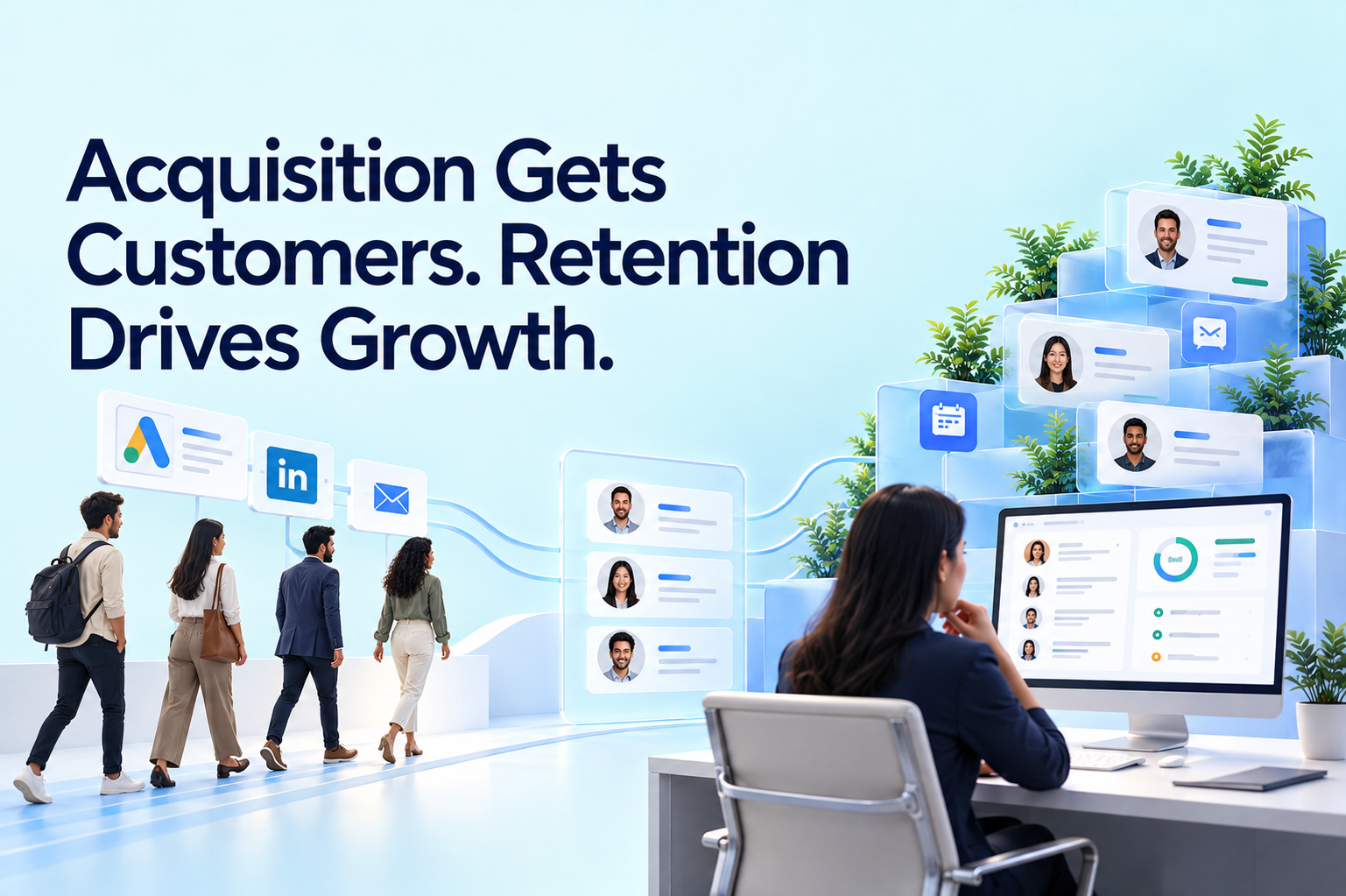
Retention marketing channels are the touchpoints a business uses to keep a customer after the first sale: email, in-app messaging, SMS, CRM-triggered outreach, support conversations. Acquisition channels have one job: to get someone to say yes once. Retention channels have to earn attention again and again.
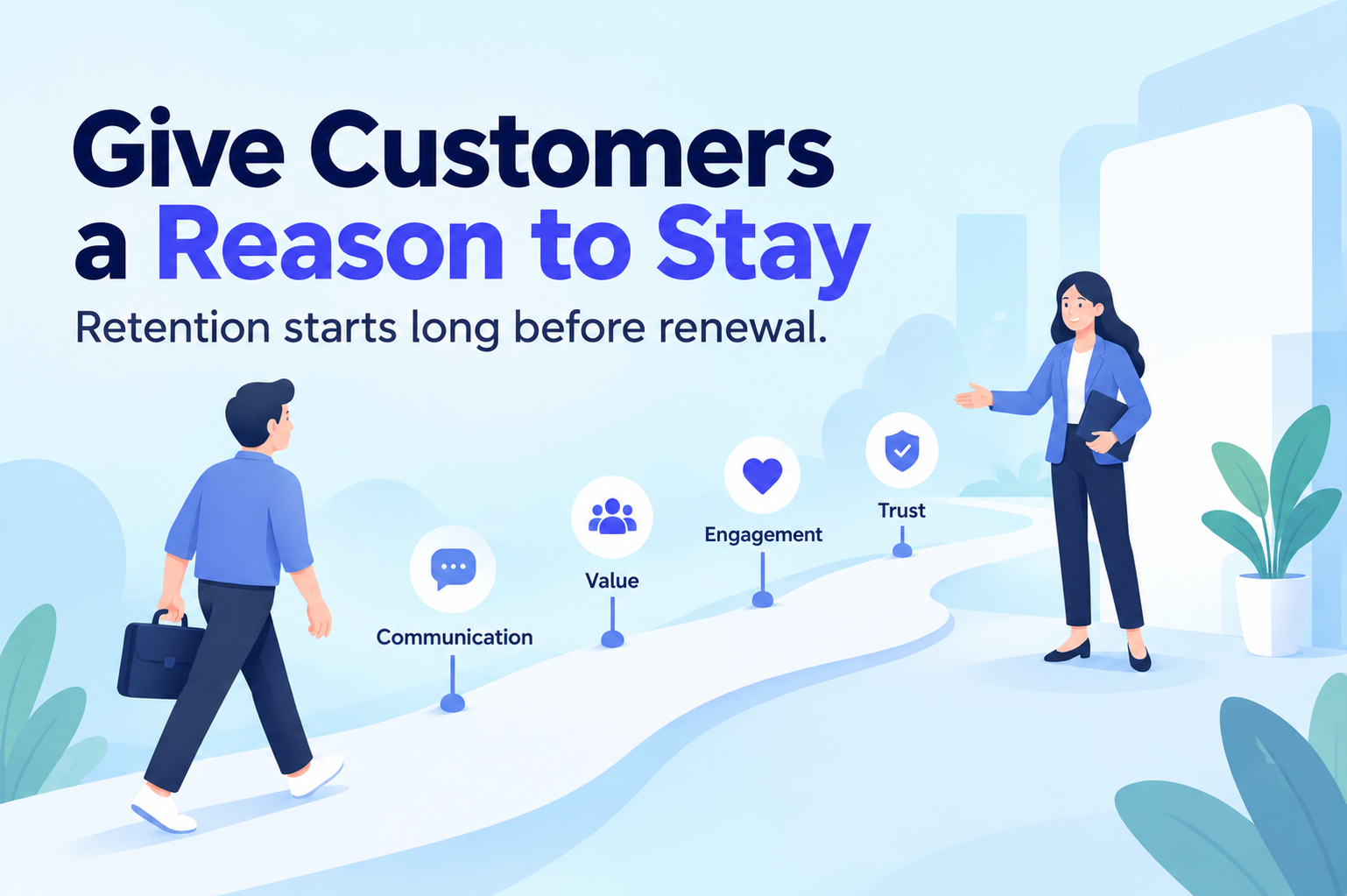
Customer retention breaks down when these channels run on their own. A renewal email that ignores last week's support ticket reads as carelessness, and that gap is where client engagement quietly erodes. Across the customer lifecycle onboarding, adoption, renewal, expansion the right channel keeps changing, and B2B customer engagement suffers whenever email, CRM and messaging run as three separate jobs instead of one. The goal isn't more retention marketing channels; it's fewer, better-timed ones working as a system.
How CRM creates the customer context behind retention
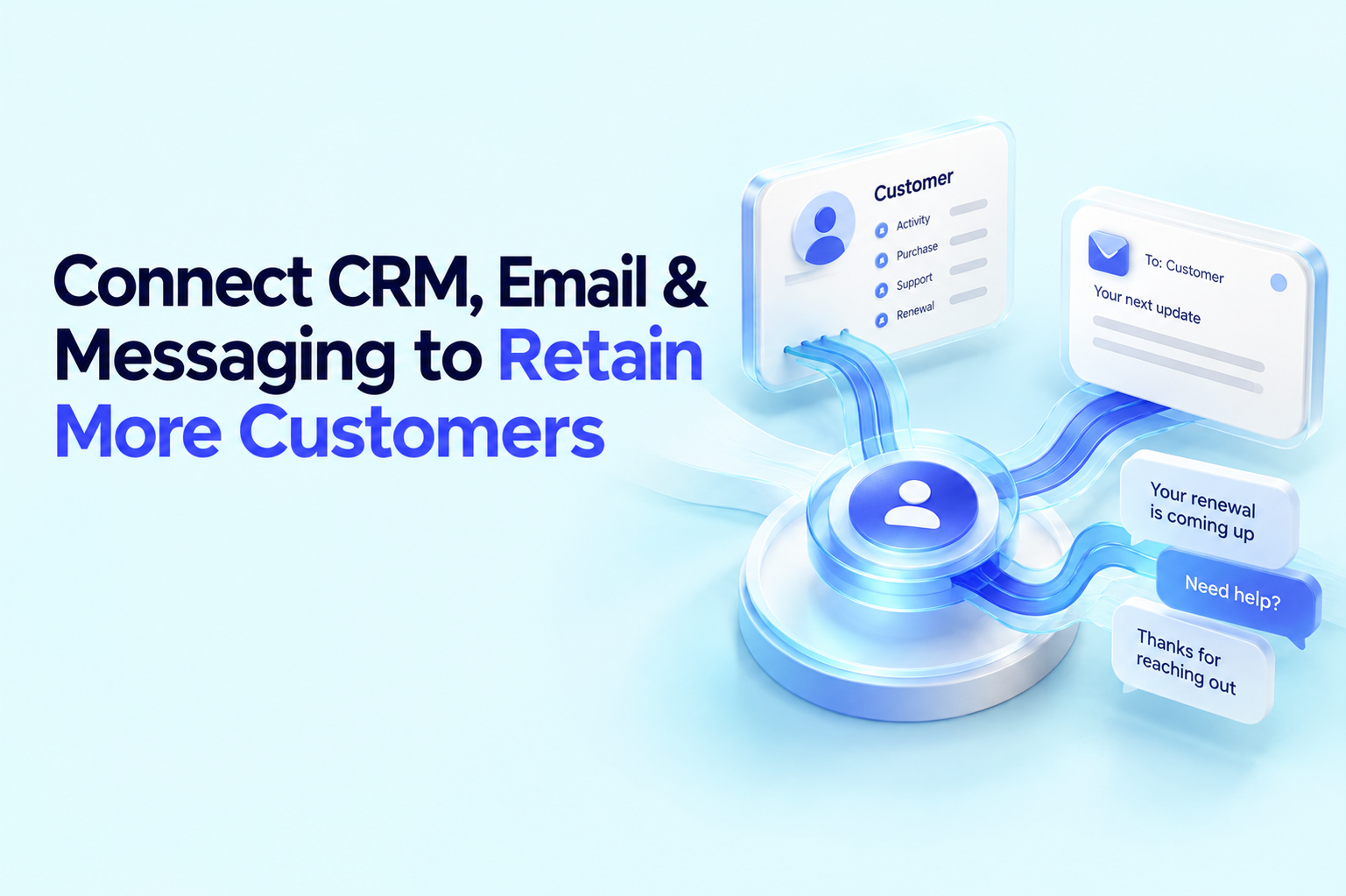
CRM creates the customer context behind retention by bringing usage, purchase, support, and contract data into one place. CRM marketing uses that context to decide which customers need attention, when they should be contacted, and what message is most relevant to them. CRM comes first because email and messaging are only as good as the data feeding them.
How CRM improves customer retention
CRM improves customer retention by identifying changes in customer behaviour early and helping teams act before those changes become churn signals. A CRM-led retention strategy usually covers:
- Flagging accounts with dropping usage before renewal
- Segmenting by lifecycle stage, not industry or size alone; lifecycle marketing run through the CRM
- Surfacing upsell timing from past behaviour, not a fixed calendar
- Routing at-risk accounts to a person before churn shows up in the numbers
- Feeding activity into email and messaging, so neither is guessing
Put simply, what is CRM marketing? It is the use of customer data to guide what a business communicates, to whom, and when. CRM marketing draws on information such as customer activity, purchase history, support interactions, and renewal dates to make communications more relevant.
How email marketing improves customer retention
Email marketing improves customer retention by keeping customers informed, engaged, and moving through the right stage of the customer lifecycle. Retention email marketing works best when email is treated as a relationship channel rather than a broadcast tool. As part of a broader retention marketing strategy, email can support ongoing client engagement without overwhelming customers.
If executed well, an email can feel like a note from someone paying attention. The message reflects what the customer has done, what they may need next, or where they are in their journey.
Benefits of email marketing for customer retention
Done right, the benefits of email marketing for customer retention may show up as the following:
- Higher open rates, because the email matches where the customer actually is
- Lower support load, since proactive email marketing campaigns answer questions before they're asked
- Clearer attribution, since email retention data ties directly to renewal numbers
- Better fit, since customer engagement solutions built on CRM data replace one-size-fits-all sends
Tracking and analysing email campaign performance
Open rate alone says little about email marketing for customer retention; click-through, reply rate and post-email product usage tell you whether the message mattered. Tracking these signals across the customer lifecycle also helps teams understand which email marketing campaigns contribute to meaningful client engagement rather than simply generating opens.
Do's and don'ts of email marketing
Effective retention email marketing keeps communication relevant, timely, and connected to the customer's journey. The strongest approach uses customer data to determine what to send and when, while giving customers enough space to engage on their own terms.This is where lifecycle marketing and CRM marketing work together: lifecycle marketing determines where the customer is in the journey, while CRM marketing provides the customer context needed to make each message relevant.
How messaging improves customer retention at the right moment
Customer messaging improves retention by reaching customers when something needs attention now. Email retention data can show what worked over days or weeks; messaging captures what is happening in the moment. It is a different tool for a different job.
The useful question is not simply which channel gets the most attention. It is whether the customer needs a quick answer, an immediate update, or help while they are already doing something.
SMS for customer retention
SMS fits time-sensitive, short messages: a renewal deadline, a shipping delay, or a payment failure. Text messages are typically seen much faster than email, which makes SMS useful when timing matters. The often-cited 98% SMS “open rate” is not directly measurable, so it is better to focus on SMS response and click-through rates rather than comparing open rates across channels.
How conversational messaging improves customer retention
A real-time reply on WhatsApp, live chat or a support thread keeps the conversation in one place, instead of making a customer repeat themselves across email, chat and phone.
In-app messaging for timely customer engagement
In-app messaging reaches customers while they're already using the product. It is the strongest channel for onboarding nudges and feature announcements. Together, these give client engagement moments email alone can't reach.
Making retention channels work together across the customer lifecycle
Getting customer messaging right across channels starts with mapping it to the lifecycle, not sending everything everywhere.
What's the right channel for each stage of the customer lifecycle?
The right channel depends on what the customer needs at that stage of the customer lifecycle. In-app messaging works well when guidance is needed inside the product, while email, SMS, CRM-triggered outreach, and other retention marketing channels have different jobs as the relationship develops.
How do you know which channel a customer prefers?
CRM data can show which channels customers respond to most, through reply rates and click patterns. Coordinating email, SMS and in-app messaging around that data is what keeps retention marketing channels from becoming noise.
How marketing automation improves customer engagement and retention
None of this scales without automation. Automating lifecycle marketing means setting rules once and letting customer behaviour determine what happens next: a usage drop can trigger an email, a missed login can prompt an in-app nudge, and a support interaction can change what message comes next.
An example is NAGA, which in 2025 consolidated three previously disconnected marketing platforms into Microsoft Dynamics 365 Customer Insights. The system allowed the company to automate personalised engagement across email, in-app and push notifications, WhatsApp, Telegram, Messenger, web chat, and SMS. Microsoft reports that NAGA cut campaign launch times from days to hours, making it possible to respond to customer behaviour in real time.
The point is simple: B2B customer engagement becomes easier to scale when the system can react to customer activity automatically, while the marketing team focuses on the interactions that actually need human attention.
How to maximize customer retention with onboarding metrics
You can maximize customer retention with onboarding metrics by using CRM marketing and email marketing campaigns to respond to customer behaviour early. A customer who finishes setup in week one and one who stalls need a different retention strategy from day one, not after a 90-day report. Tracking time to first value, feature adoption and early support volume helps lifecycle marketing maintain relevant client engagement across the customer lifecycle.
How CRM with email marketing improves customer retention
Connecting CRM data to email marketing campaigns turns customer behaviour into customer retention marketing, instead of another content calendar. The CRM knows what happened; retention email marketing responds with something useful, triggered by that activity rather than a fixed date. This creates a more relevant experience across the customer lifecycle, while giving teams a clearer way to support ongoing client engagement.
The payoff can be substantial. Research associated with Bain’s Fred Reichheld has found that a 5% increase in customer retention can increase profits by 25% to 95%, although the impact varies by industry and business model.
This is where Envizon comes in. Envizon helps B2B teams connect the CRM, email, and messaging tools they already have into a coordinated retention marketing system, so CRM marketing can turn customer data into relevant communication, while lifecycle marketing helps determine what customers need at each stage instead of letting that data sit in separate systems and disconnected workflows.
Email marketing supports inbound by turning website visitors and leads into ongoing conversations. It can nurture prospects, share relevant content, support conversions, and keep existing customers engaged.
Email supports ongoing engagement and education, while SMS works well for timely, action-oriented communication. Together, they can support acquisition, conversion, retention, and reactivation.
Key retention marketing channels include email, CRM, in-app messaging, SMS, customer messaging, and human-led outreach. The right mix depends on the customer lifecycle stage and the type of interaction required.
Customer messaging creates direct, timely conversations with customers through channels such as live chat, WhatsApp, and support messaging. It helps businesses respond to questions, resolve issues, and maintain context across interactions.
Businesses can improve engagement after onboarding by monitoring product usage, segmenting customers by lifecycle stage, sending relevant communications, and responding to changes in behaviour with timely outreach.
Retention marketing focuses specifically on keeping existing customers engaged and reducing churn. Lifecycle marketing covers the broader customer journey, from onboarding and adoption through renewal, expansion, and reactivation.
Effective tactics include personalised email campaigns, lifecycle-based messaging, usage-triggered outreach, proactive support, renewal reminders, in-app engagement, customer segmentation, and CRM-driven reactivation campaigns.
Customer retention is the process of keeping existing customers engaged and encouraging them to continue using a product or service.
Email marketing helps keep customers informed and engaged by delivering relevant messages based on their needs and stage in the customer journey
CRM provides customer data and context, while messaging helps businesses reach customers with timely and relevant communication based on their behaviour.
B2B SaaS GTM strategist and Founder of Envizon. With 18+ years leading marketing across startups like iMocha, Lavelle Networks, CloudCherry, and Hotelogix, she now helps early-stage founders build GTM engines that scale.
About Envizon
Envizon helps early and growth-stage B2B SaaS startups build their go-to-market (GTM) engine, before they hire a full in-house team.We combine Fractional CMO leadership with a full-stack execution team across outbound, inbound, content, AI, paid, and PR.Not an agency. Not just advisory. Envizon acts as your internal GTM partner- bringing strategy, systems, and execution together to help founders scale faster and smarter.
Knowledge Themes
Looking for the best B2B marketing agency alternative?
Envizon combines Fractional CMO leadership with execution across all GTM channels