Net Revenue Retention: What It Means and Why It Matters for SaaS Growth

Most SaaS teams can rattle off their NRR without missing a beat, but far fewer actually know what’s driving the number under the hood. Here’s the reality: NRR is one of the most effective ways to evaluate whether a business is truly compounding, but it is limited unless you look at it side-by-side with gross revenue retention and break it down by customer segment. Read among other SaaS metrics, the NRR meaning gets much clearer.
In this guide, you will learn how to:
- Calculate NRR accurately while avoiding common data pitfalls like new-logo leakage.
- Choose the right timeframe (Monthly, Quarterly, or Trailing 12 Months) for your operational goals.
- Benchmark your performance against standard segments and pricing models.
- Use segmented reporting to uncover where growth thrives and where retention breaks.
What Is Net Revenue Retention?
NRR is the percentage of recurring revenue you keep and grow from existing customers over a set period, after subtracting churn and downgrades and adding upgrades. This NRR meaning applies whether you track ARR retention or MRR retention.
The net revenue retention definition comes down to one question about last year's customers: do they pay you more or less today? Above 100%, the base grew without a single new sale, and below 100%, you are refilling a leaking bucket.
What NRR includes and excludes
NRR revenue covers every recurring change inside the existing base: upgrades, cross-sells, and usage growth on the plus side, downgrades and cancellations on the minus side. New-logo revenue and one-time fees such as implementation work stay out.
How to define the starting customer cohort
The cohort is every customer who was paying on the first day of the period, and nobody else. Freeze that list before you calculate anything, or a customer who signs in month three and upgrades in month five will inflate expansion. Only the NRR revenue from that list counts.
Net revenue retention vs. net dollar retention
They are the same NRR metric under two names. Some investors prefer net dollar retention, and "net retention rate" is a third label for the same calculation.Net dollar retention carries the same NRR meaning and the same math, so the net retention rate you report should use one agreed cohort.
How to Calculate NRR
The net revenue retention formula takes the cohort's starting recurring revenue, adds expansion, subtracts contraction and churn, and divides by the starting revenue.
A Net revenue retention formula simply looks like this: Starting MRR + Expansion - Contraction - Churn) / Starting MRR x 100.
Use ARR instead of MRR if you report annually.
Positive NRR and Negative NRR example
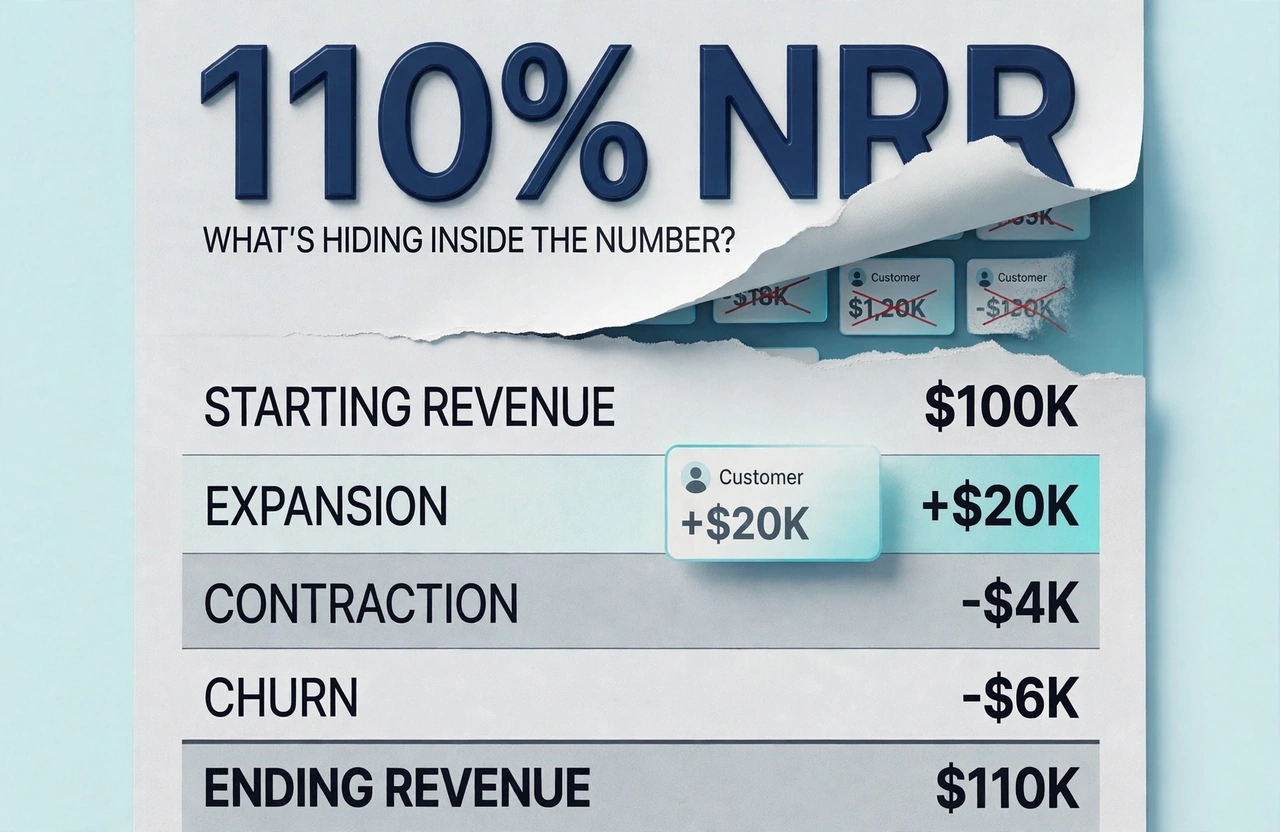
Positive NRR (above 100%) means your existing customers spend more over time, driving organic growth without new sales, while negative NRR (below 100%) means churn and downgrades outpace expansion, creating a leaking bucket. Consider this: two companies start the year with $100,000 in monthly recurring revenue from existing customers.
Company A reaches 110% because upgrades outrun losses. Company B lands at 75% because churn and downgrades remove $30,000 while expansion adds back only $5,000.Plugging each column into the NRR formula gives those results, a simple MRR retention check you can repeat monthly.
Common NRR calculation mistakes
The most frequent error is letting new-logo revenue leak into the expansion term, which inflates the NRR calculation and hides a retention problem. Another major misstep is picking the wrong timeframe: relying on volatile monthly numbers without quarterly check-ins or Trailing-12-Month (TTM) smoothing can lead to overreacting to short-term noise, missing mid-term trends, or masking seasonal churn. Fixing the cohort and the window keeps every NRR calculation comparable from period to period.
What Is a Good NRR Rate?
Anything above 100% is good, since the existing base is growing on its own. Net revenue retention benchmarks from the 2026 Aleph and Benchmarkit report put the median B2B SaaS NRR at 102%. Treat NRR benchmarks as a reference point for your own trend.
How to interpret NRR percentages
According to a Technource report, a net retention rate below 100% means the base is shrinking. From 100% to 110% is healthy, 110% to 120% is strong, and above 120% is best-in-class.
Why benchmark context and segmented NRR matter
Read SaaS NRR benchmarks as ranges, because they shift with contract size, pricing model and the dataset behind them.
- Enterprise (ACV over $100K): median NRR of about 118%
- Mid-market (ACV 25k -100k): about 108%
- SMB (ACV under $25K): about 97%
- Usage-based pricing: about 108%, against 98% for seat-based
For instance, a blended 105% can hide an enterprise book at 120% carrying an SMB book at 90%. Segmented NRR SaaS reporting, split by plan, contract size and tenure, shows where growth comes from and where SaaS retention is breaking. Compare yourself only with companies that sell the way you do.
Why NRR Matters for SaaS Growth
NRR matters because it shows how much revenue your installed base adds before sales closes a single new logo, which makes it one of the SaaS metrics investors check first.It also gives customer retention SaaS teams a shared target.
- NRR creates compounding growth - Each year's expansion builds on a larger base. At 110% ARR retention, a $1M base becomes $1.1M next year and $1.21M the year after with no new sales.
- NRR improves growth efficiency - High NRR makes growth cheaper because expansion usually costs less to win than a new logo.
- NRR reveals product value - Rising NRR means customers find enough value to pay more each year. A falling number belongs on the agenda of NRR customer success reviews.
- NRR is not a complete health metric - NRR nets expansion against losses, so one large upsell can cover a dozen cancellations and keep the headline number healthy.No single NRR metric can carry the full story.
Metrics to analyze alongside NRR
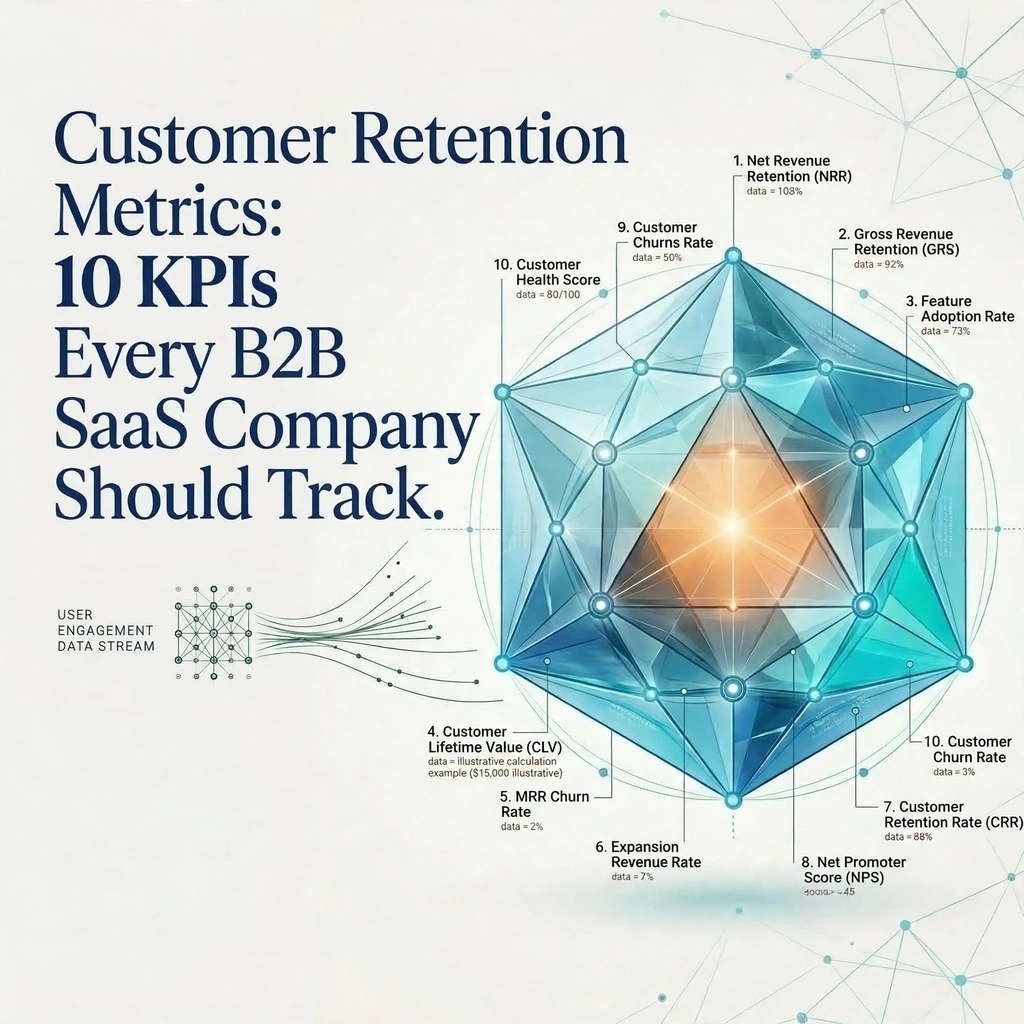
Some other SaaS metrics that fill in what NRR leaves out:
- Gross revenue retention, for what you kept before expansion
- Logo retention, which counts customers instead of dollars
- Churn SaaS rate by segment
- ARR retention by cohort
NRR vs. GRR: What's the Difference?
NRR vs GRR comes down to expansion: NRR includes it and can exceed 100%, while GRR excludes it and caps at 100%. Gross vs net retention shows whether growth is earned or only kept.
Gross revenue retention formula
GRR is the NRR formula without expansion: (Starting MRR - Contraction - Churn) / Starting MRR x 100.
When to use NRR
Use NRR when the question is growth, such as expansion targets or investor updates. It shows how much the installed base can carry.
When to use GRR
Use GRR when the question is whether customers are staying, since upsells cannot lift it. The Aleph median is 84%. That is the practical side of NRR vs GRR
How high NRR can conceal churn
A company reporting 112% NRR with 78% GRR is losing more than a fifth of its base while a few large accounts cover the gap. In a gross vs net retention comparison, that 34-point difference is the warning sign, because those accounts will not expand forever.
How to Improve Net Revenue Retention
Customer retention in SaaS work is mostly a matter of order. Stop the leaks first, then build expansion into the product, and make sure someone owns each step.
- Reduce churn before pursuing expansion - A dollar saved from cancellation counts toward NRR just as an upsell does, and it usually costs less. Review the churn SaaS lost last quarter and fix the most common cause first.
- Build expansion paths into the product - Seat-based plans, usage tiers and add-on modules let revenue rise as customers get more from the product.
- Use customer health and product data - Feature adoption and support ticket volume tend to move before a renewal decision does. A health score built from them gives customer success time to step in.NRR customer success teams can use that score to protect SaaS retention.
- Segment customers and personalize retention strategies - SMB accounts respond to lifecycle email and in-product prompts because the contract rarely justifies a call. Enterprise accounts need an executive sponsor and regular business reviews tied to their goals.
- Assign shared ownership across teams - NRR customer success teams usually own renewals, but retention depends on more than renewals. Product owns adoption, sales owns upsell, and marketing owns expansion messaging, so all four should share one NRR target.
NRR Reporting Best Practices
Good SaaS retention reporting uses one definition, shows results by segment, places GRR beside NRR and explains every movement.
- Use consistent revenue and cohort definitions - Write down what counts as NRR revenue, how the cohort is frozen and which window you use. Changing the MRR retention logic mid-year makes trend lines unreliable.
- Report NRR by segment, plan, and customer tenure - A customer in month six behaves differently from one in year three. Show both cuts so a strong mature base does not hide a weak new cohort.
- Pair NRR with GRR, logo retention, and churn - No single figure covers every case. Gross vs net retention, besides logo retention and churn, shows whether growth comes from keeping customers or from a few large expansions, which separates customer retention SaaS boards can trust from retention that only looks good.
- Investigate the drivers behind every NRR change - Every move of more than a point or two deserves a named cause, down to the accounts involved. Was it one large upgrade, a pricing change or a cluster of cancellations?
Use NRR to Measure Sustainable SaaS Growth
The NRR SaaS leaders trust is defined once, segmented and checked against GRR. Used that way, it shows whether growth comes from customers who stay and spend more. Treat the NRR metric as a diagnosis, then fix what it points to.
If your NRR is flat and you cannot explain why, Envizon's fractional CMO and GTM services can help you find the leak and build a retention and expansion plan.
NRR can exceed 100% when expansion revenue from existing customers, such as upgrades, cross-sells, or increased usage, outweighs churn and downgrades. At 110% NRR, a $1 million starting customer base generates $1.1 million in recurring revenue over the measurement period, excluding new-customer revenue. GRR cannot exceed 100% because it excludes expansion revenue.
Use the NRR formula: (Starting MRR + Expansion - Contraction - Churn) / Starting MRR x 100. Start with the revenue from customers who were paying on day one, and leave out anyone who signed later. Use ARR instead of MRR if you report annually.
Fix churn first, since every cancellation you prevent counts toward NRR. Then build expansion paths into the product, such as seat tiers, usage pricing and add-ons. Use health scores to flag at-risk accounts early, and give customer success, product, sales and marketing one shared NRR target.
It depends on the goal. Monthly NRR catches problems fastest but swings the most. Quarterly gives teams a steadier read, and trailing 12 months smooths out seasonality. Pick one window, label it on every report and keep it consistent from period to period.
Above 100% is good. The 2026 Aleph and Benchmarkit report puts the median B2B SaaS NRR at 102%. From 100% to 110% is healthy, 110% to 120% is strong, and above 120% is best-in-class. Enterprise tends to run higher than SMB.
NRR is the percentage of recurring revenue you keep and grow from existing customers over a set period. It adds upgrades and subtracts churn and downgrades. New-logo revenue is excluded. An NRR above 100% means your existing customers are spending more than they did at the start.
NRR includes expansion revenue and can exceed 100%. GRR leaves expansion out and caps at 100%, so only churn and downgrades move it. NRR shows whether the customer base is growing, while GRR shows whether customers are staying.
B2B SaaS GTM strategist and Founder of Envizon. With 18+ years leading marketing across startups like iMocha, Lavelle Networks, CloudCherry, and Hotelogix, she now helps early-stage founders build GTM engines that scale.
About Envizon
Envizon helps early and growth-stage B2B SaaS startups build their go-to-market (GTM) engine, before they hire a full in-house team.We combine Fractional CMO leadership with a full-stack execution team across outbound, inbound, content, AI, paid, and PR.Not an agency. Not just advisory. Envizon acts as your internal GTM partner- bringing strategy, systems, and execution together to help founders scale faster and smarter.
Knowledge Themes
Looking for the best B2B marketing agency alternative?
Envizon combines Fractional CMO leadership with execution across all GTM channels