Signals your GTM engine is misaligned

A strong GTM strategy aligns marketing, content, and customer insight to reach the right customers and drive interest. It spans everything from pricing and positioning to launches, enablement, and promotion. Beyond new product launches, GTM plays a key role in refreshing existing products and fueling growth. No matter the stage, whether it is new markets, new products, or expansion, a solid GTM strategy acts as a guide through an increasingly complex market.
So, a lot hinges on your GTM strategy working like a well-oiled machine. However, sometimes, you’ll find it feeling forceful, fragile, and overtly dependent on just one channel. And that’s when you know your GTM is misaligned.
Here are a few signals to look for that might help you identify and address misalignment in your GTM strategy.
Signal 1: Are your key components still feeling “key”
The backbone of any good GTM strategy hinges on a few questions:
- What problem does your product solve?
- Who is your TG and what segments are the most relevant in that TG?
- Why would buyers prefer your products over any competitor’s?
- Where in the world your solutions have the most relevancy?
- And, lastly, how should you price it?
Businesses are in a race for relevancy these days. There’s a rush to make everything AI-aligned and customer needs are pivoting ever so frequently because of this. Asking yourself these fundamental questions (and fixing them) can help your GTM team stay relevant.
In case you’re wondering how to define your ICP for SaaS, check here.
Signal 2: There’s no single source of truth for data
When your GTM engine is aligned, teams operate from the same set of facts. When it isn’t, data lives in fragments; it is often spread across tools, dashboards, and spreadsheets and every function tells a different story.
You’ll notice this happening when:
- Marketing reports one version of pipeline, sales reports another, and finance trusts neither
- Teams debate numbers instead of decisions
- Forecasts change depending each team
Without a single source of truth, alignment breaks down quickly. Campaign performance becomes hard to evaluate, handoffs between teams weaken, and trust erodes. Decisions get delayed, not because teams lack insight, but because they lack agreement.
The impact is subtle but serious. When data isn’t unified, teams optimize locally instead of globally.
Signal 3: Your campaigns try to speak to everyone (but resonate with no one)
One of the strongest indicators of GTM misalignment is a lack of clarity around who you’re actually building and selling for. Ill-defined markets equate to resources being spread thin, messaging being generic, and your sales always wondering “but why must customers care about this?”
If that’s happening, it is then time to ground your GTM strategy in rigorous market research. Identify and prioritize segments that align with your product’s strengths, validate them through customer insights, and clearly articulate the problems you solve for each market. This process is worth pausing your GTM efforts to get this right.
Signal 4: Marketing, Sales, and CS have their own languages
Your website page, sales pitch, customer communications, and anywhere you’re reaching out to customers must have a unified language system. When each team speaks differently, customers receive mixed signals, creating confusion and mistrust.
This is a core reason why handoffs often break: your marketing reaches out to them with a certain messaging or solution and sales enter with another expectation. At this point, customers are bound to ask “but your marketing team didn’t say this?” This breaks trust, and inevitably leads to churn.
GTM strategy doesn’t only mean tracking the same metrics or systems, it is equally about speaking in one voice.
Here’s a quick GTM readiness framework that you and your teams can follow to stay on track.
Signal 5: Your customers and prospects are unsubscribing from EVERYTHING
When unsubscribe rates spike (or worse, when entire accounts go dark) it’s a strong signal that your GTM motion has become overwhelming, not engaging.
This often happens when:
- Marketing, sales, customer success, and product all reach out independently
- Prospects receive multiple emails, messages, calls, invites, and ‘touches’ in a single day
- Communication lacks coordination, context, and timing
As harsh as this may sound, this isn’t “high touch,” this is simply overwhelming. A unified comms model, where touchpoints are defined for each team and handoffs are done by stage change, is a better strategy than doing everything, all at once.
Here’s an example of what we manage for a client:
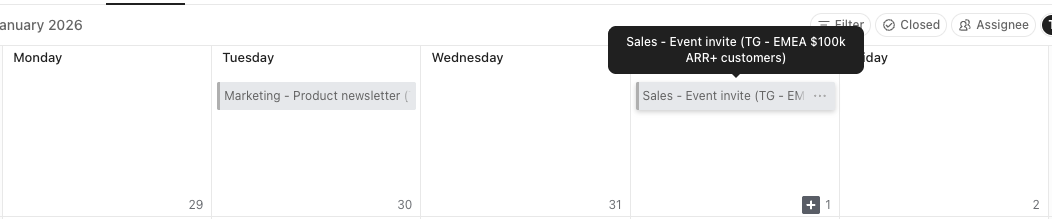
This simple calendar hack helped us save a lot of overwhelmed customers and prospects.
Misalignment is the surest way to make growth feel unpredictable and uncertain and to erode customer trust.
A quick way to check alignment? Put your product, marketing, sales, and CS in the same room to describe your ICPs.
FAQs
GTM misalignment happens when marketing, sales, product, and customer success operate with different goals, messaging, metrics, or data. Instead of functioning as one cohesive growth engine, teams move in parallel but disconnected paths, leading to poor conversion, slower growth, and reduced customer trust.
Common signals include:
- Conflicting pipeline and performance metrics across teams
- Generic messaging that tries to target everyone
- Fragmented customer communication
- High unsubscribe or disengagement rate
- Lack of clarity around ICP and segmentation
- Inconsistent positioning across marketing, sales, and CS
If multiple teams tell different stories about the same funnel, misalignment is likely.
GTM strategy should be reviewed:
- Quarterly for fast-moving SaaS businesses
- Bi-annually for enterprise or complex sales motion
- After major product launches, pricing changes, or market shifts
Frequent iteration helps teams stay aligned with evolving customer needs and market dynamics.
B2B SaaS GTM strategist and Founder of Envizon. With 18+ years leading marketing across startups like iMocha, Lavelle Networks, CloudCherry, and Hotelogix, she now helps early-stage founders build GTM engines that scale.
About Envizon
Envizon helps early and growth-stage B2B SaaS startups build their go-to-market (GTM) engine, before they hire a full in-house team.We combine Fractional CMO leadership with a full-stack execution team across outbound, inbound, content, AI, paid, and PR.Not an agency. Not just advisory. Envizon acts as your internal GTM partner- bringing strategy, systems, and execution together to help founders scale faster and smarter.
Knowledge Themes
Looking for the best B2B marketing agency alternative?
Envizon combines Fractional CMO leadership with execution across all GTM channels